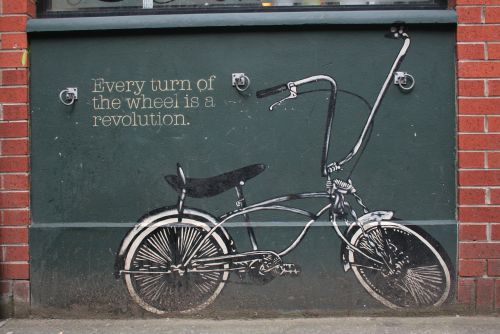
Bring a Friend or Ten.

 People who recognize the role of bicycles in sustainable transportation have been talking this week about comments by U.S. Secretary of Transportation Ray LaHood. On his blog this week, he wrote:
As I said today in testimony before the House Energy and Commerce Committee, this includes fostering communities where bicyclists feel both safe and welcome on the roadways. Bike-friendly development also has the potential to contribute significantly to the revitalization of downtown districts and offer an alternative to sprawl and automobile-focused commuting.
This line of thinking marks a departure from LaHood’s predecessor, who didn’t see bicycles as having much to do with transportation.
LaHood issued a call to arms, of sorts, describing funding sources for bicycle and pedestrian infrastructure and urging advocates to “get their cities and states to request funds for these projects.”
Here in Savannah, a group of advocates has already been following LaHood’s advice and there are two important opportunities for the public to show support in the near future.
While LaHood’s comments are encouraging, I can’t help but recognize the reality of the situation. As a bicyclist and pedestrian, I must lobby local and state officials and plead for inclusion in transportation funding requests. Yet as a motorist, no such action is required of me. Automobile infrastructure is automatic, even when it isn’t wanted, even when it excludes other users and even when it comes at such a high social cost.

A little girl was hospitalized Friday afternoon after witnesses say she was struck by a minivan.
The accident occurred at the intersection of Triana boulevard and village drive southwest just before three this afternoon. A witness told WAFF 48 News that a crossing guard had her hands in the air, instructing traffic to stop, but the minivan continued through the intersection.
The van was able to stop before seriously injuring the girl, who was attempting to cross Triana Boulevard.
Huntsville police officers directed traffic for a short while after the accident. A HEMSI crew transported the girl to the hospital as a precaution, but she is expected to be fine.


Neighbors believe strongly that some type of overpass needs to be installed at University and Meadow Drives to prevent other accidents involving those crossing over to happen
Venton BlandinReporter
April 4, 2009
Huntsville - We are learning new details about a deadly accident in Huntsville. A car hits and kills a woman Friday night at the intersection of University and Meadow Drives.
Huntsville Police say a vehicle traveling west bound on University Drive hit the woman as she was crossing the street. The driver told police he did not see the woman. The ambulance rushed her to the hospital, but she died a short time later. We confirmed the victim's name is Lashun Lynch.
Those who live a few feet from the intersection say crossing the road is very dangerous at all times of the day.
Trayshell Bright and her family lives very close to where Lashun Lynch was hit by a car. She can see the spot along with heavy traffic from her house.
"The traffic is very bad as well along with crossing the highway," said Resident Trayshell Bright.
Bright says she see kids running across the highway as well as adults. Some of her neighbors who didn't want to go on camera say the same thing. Huntsville Police have worked several accidents involving cars hitting people in the road.
We watched several people cross over University Drive. Almost all of them failed to use the crosswalk. Some of them annoyed drivers. Some neighbors say jay walking is part of the reason for people getting hit.
Bright goes even further blaming the traffic lights.
"By the time you get halfway across University Drive, to the side where we live, it's already changed," added Bright.
We decided to see for ourselves. We hit the button at the pedestrian crosswalk to stop traffic at University and Meadow Drives. It took nearly two minutes to change.
WHNT NewsChannel 19 Reporter Venton Blandin crossed University Drive back and forth two times when signaled by the cross walk. One time, a car stopped allowing him to cross, but another time a car came very close to hitting him.
The video does seem to back up what Trayshell Bright says.
"Where you cross the street, it's not even safe to cross it, with mashing the button to cross it," added Bright.
Using the crosswalk button gives a little more than 20 seconds for someone to cross University Drive.
Neighbors believe strongly, some type of overpass needs to be installed at University and Meadow Drives to prevent other accidents involving those crossing over to happen.

 Ladies Please Join Us This Friday April 10th For A Evening Ride Out On The Town!
The Mississippi State University bike program will undergo a metamorphosis as more bicycles will be purchased with new features in the fall semester.
Some of the upgrades will include steel pedals, stronger tires and the placement of baskets on the front of them.
Director of parking services Mike Harris said students are really interested in the program.
"During Spring Break, we accounted for 90 bikes," he said. "This is a great number to be able to account for. It shows that the students are buying into the program and regulating it themselves."
Harris said the bikes were part of a pilot program to begin with just to see how it would work.
"In our opinion, it has been very successful to the point of us looking to purchase another 100 bikes," he said.
Associate dean of students Thomas Bourgeois said he is positive about the MSU bikes.
"We are very excited about the bikes and will continue to add to the fleet," he said. "It has been a phenomenal success."
Bourgeois said the biggest problem with the bikes was where to distribute them. Also, students complained about the seats being uncomfortable and either too high or too short for them.
Student Association President Blake Jeter said the MSU bikes not only thrived, but bike travel in general on campus has increased.
"This year there have been three times more students than last year registering their bikes on campus," Jeter said. "There are now 1,200 bikes registered compared to the 400 last year."
Considering the students' primary problem with the bike system is the low number of bikes available, he said Mississippi State officials plan to order 100 bikes a year for the next five years.
Sophomore philosophy major Marshall Jones said he enjoyed the bikes at first but then struggled to find one on campus.
"As a student who often has to rush to class, the student bikes often helped me in getting to class just in time," he said.
Jones said shortly after the bike system was created, he started seeing fewer and fewer bikes around campus.
"Now it has gotten to the point where I'm lucky to see one once a week," he said.
Jones said he thinks it was a good idea, but more thought should have been involved in the process.
"I definitely think that the school should either invest in some kind of tracking device for the bikes or cut their losses and sell what bikes they have left for money they could use elsewhere," he said.
Battle meets his first big test with resolve; will it be enough?
Huntsville Mayor Tommy Battle faced the first major test of his administration last week with the public outcry over the city's $2.8 million project to remove the brick sidewalks around the courthouse square.
Battle handled the issue calmly but with resolve. Still, the question remains as to whether that approach will be sufficient with other issues or whether the public, angry over this decision, will now become angry over others.
On March 13, the city awarded a contract to remove the brick sidewalks and replace them with concrete sidewalks bordered with brick. Some trees will be taken down; many more will be planted.
Parking spaces around the courthouse will increase. Bike racks will be installed. New street lights are going in. Other aesthetic improvements are set, as well.
But it's the sidewalk issue that has fired up the citizens. They argue that the bricks add charm and character to the area. (True enough.) They question the city's rationale that because women in heels were tripping over the edges of the brick, those bricks constituted a hazard and, thus, exposed the city to liability.
Police say a motorist bit off a chunk of a man's ear after the man complained about the motorist's speeding.
Thirty-one-year-old Jeffrey H. Guffey told police he was riding a bicycle Wednesday when he shouted at the driver of a sport-utility vehicle that was speeding down a residential street.
Guffey told police the driver pulled over, got out, knocked him to the ground and began biting his ear, spitting out the pieces.

Residents commuting downtown are encouraged to leave their cars at home this Friday and join Savannah leaders for the continuing monthly series of First Friday Dump the Pump Bicycle Convoys.
The Bicycle Convoy leaves at 8 a.m. Friday, April 3, from two locations—the Habersham Village parking lot (Habersham and 61st streets) and Baldwin Park (Atlantic and 41st streets)—and joins together at Habersham and 41st for the ride downtown. The Convoy heads north on Lincoln Street and finishes at Davant Park, on the south end of Colonial Cemetery, with free coffee and eats provided by Jittery Joe’s.
The ride will be led by experienced bicycle commuters from the Savannah Bicycle Campaign. Rain date will be the following Friday, April 10.
Dump the Pump is a series of events intended to raise awareness about the benefits of using alternative modes of transportation such as bicycling, walking, car pooling and mass transit. It is sponsored by the City of Savannah, the Savannah Bicycle Campaign, the Savannah Development and Renewal Authority, Coastal Commuters, Chatham Area Transit, and the Pedestrian Advocates of the Coastal Empire.
Area residents can learn more about local transportation options at http://www.savannahtransit.com or http://www.bicyclecampaign.org, or find car pool partners at http://www.coastalcommuters.org.
The same federal stimulus funding that has given Louisville millions to buy electric buses, pave roads and pour sidewalks is now handing the city $1.8 million to build a downtown center for commuting bicyclers.
The funds will pay for most of the cost to build the center at one of a handful of city-owned sites downtown, Mayor Jerry Abramson said.
Metro Government officials are in discussion with at least one local corporation about helping finance the project, perhaps in exchange for naming rights or other considerations.
The center, a glorified bike station, "would be a great amenity for downtown residents who don't own a car, and also for bikers who commute to work," Abramson said.
"The automotive age as we have known it is over," said biking advocate Jackie Green, adding that a transit center catering to bicyclers might be useful to as many as 2,000 riders.
"We have to start moving about in a different manner, and this would be a step in the right direction." read more here

The picture to the left is that of Rep. Eric Cantor, R-Richmond, the House GOP whip.
Last week, the good congressman appeared on National Public Radio's morning news program, The Take Away, to criticize the federal stimulus plan.
Now, there are plenty of things to criticize in the stimulus plan. Probably 10,000 different things, in fact. Like more than $150 million in bonuses paid to the financial geniuses who led us into this mess.
But take a wild guess about what Cantor singled out as silly, stupid, and wasteful?
That's right ... bike paths and bike racks.
Here is what he said (h/t to S.D.)
"To give you just an example, $3 million went to the District of Columbia. You know what they did with that money? They’re going to go build bike paths, and they’re going to increase the number of bike racks in neighborhoods like Georgetown. I don’t think that that’s a stimulative move."
Far be it from me to tell Congress what's important and what's not.
But they're supposed to be listening to us. So if you have any views on the subject above, you can let Cantor, or your own district's representative, know here.
BTW, here is what League of American Bicyclists wrote about the subject:
It has been proven that dollar for dollar, bike infrastructure has a higher return on investment than road expansion. In fact, for every $1 million invested in an FHWA-approved paved bicycle or multi-use trail, the local economy gains 65 jobs.
That sounds like some smart stimulus to me.