
Friday Meet @ 6:30 Ride @ 7pm
SE Corner of Courthouse

I am often asked, "Why do you love bicycles?" For a few reasons, but mostly because I am in love with self-propulsion and self-motivation. I love finding solutions to problems and I want to leave the world in better condition than when I arrived. For too long we've behaved as if the resources of our world are infinite. They are not. They are finite. The disappearing species around the globe should be a canary in the coal mine for all of us.
Have you ever been witness to a baby's first steps? The open mouth smile and the parents, with arms outstretched, as the child wobbles into their waiting arms. With each step the child builds confidence and ventures further out into the world. I don't remember my first steps, but I remember the first time I found my balance and pedaled away from my father as he let go of the seat of my first bike. I remember. My heart seemed to stop and I gasped for breath. Balance. More than just a word, a metaphor. read more here

Some people go the beach when they graduate from college.
Phil Nagle is opting instead for a summer of suffering.
Nagle, 23, of Tipp City is graduating next month from the University of Cincinnati’s architectural engineering program. But before he returns to UC in the fall to finish a second major in construction management, he hopes to have done something no one has ever done before.
Nagle is planning to leave July 6 on an epic 8,000-mile bike trip through 48 states in 48 days. He hopes to raise $48,000 for the Lymphoma and Leukemia Society and land a spot in the Guinness Book of World Records.
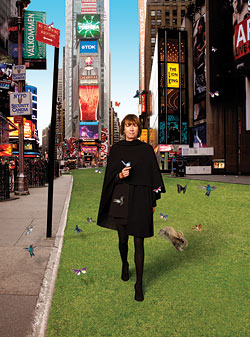
Janette Sadik-Khan, the city’s Transportation commissioner, manages to be equal parts Jane Jacobs and Robert Moses. As she prepares to close swaths of Broadway to cars next week, she is igniting a peculiar new culture war—over the role of the automobile in New York. read more here

For the fifth year in a row, cycling ruled the road in Transportation Alternatives' annual commuter race Thursday, with a biker beating a straphanger and a cabbie.
It took librarian Rachel Myers 20 minutes and 15 seconds to pedal 4.2 miles from Sunnyside, Queens, to Columbus Circle during the morning rush.
"Woo hoo!" the 29-year-old Brooklynite shouted, pumping her fist in the air. "Just goes to show that bikes rule this city!"
Subway rider Dan Hendrick - who hopped the No. 7 in Sunnyside and transferred to the No. 1 at Times Square - arrived 15 minutes later.
Hendrick, 38, usually rides the rails to work at the New York League of Conservation Voters, but he may be switching to pedal power.
"Twenty minutes saved is a lot in the morning," he said. "I could really use that time to get a latte or something."
A yellow cab rolled up to the finish line 27 minutes after Myers, costing passenger Willie Thompson $30 and precious commuting time.

The League of American Bicyclists released their second annual ranking of Bicycle Friendly States, scoring the 50 states on a 75-item questionnaire that evaluates a state's commitment to bicycling within six key areas: legislation, policies and programs, infrastructure, education and encouragement, evaluation and planning, and enforcement.
League President Andy Clarke said that "several states dramatically improved their ranking by updating their traffic codes, increasing the level of funding for bicycle improvements, implementing education programs aimed at cyclists and motorists, getting organized and hosting their first statewide bicycling conferences and events."
For 2009, the top five highest scoring states ranked one through five are: Washington, 1; Wisconsin, 2; Maine, 3; Oregon, 4; and Minnesota, 5. The lowest scoring states ranked 46 through 50 are: New Mexico, 46; Alaska, 47; Oklahoma, 48; Montana, 49; and Alabama, 50. A PDF file with complete list of state rankings is available at this link (40KB).
To learn more about the League's Bicycle Friendly State program, visit www.bicyclefriendlyamerica.org.
The Bicycle Friendly State Program is supported by program partners Bikes Belong and Trek Bicycle.


AUBAN, Germany — Residents of this upscale community are suburban pioneers, going where few soccer moms or commuting executives have ever gone before: they have given up their cars.
Street parking, driveways and home garages are generally forbidden in this experimental new district on the outskirts of Freiburg, near the French and Swiss borders. Vauban’s streets are completely “car-free” — except the main thoroughfare, where the tram to downtown Freiburg runs, and a few streets on one edge of the community. Car ownership is allowed, but there are only two places to park — large garages at the edge of the development, where a car-owner buys a space, for $40,000, along with a home.
As a result, 70 percent of Vauban’s families do not own cars, and 57 percent sold a car to move here. “When I had a car I was always tense. I’m much happier this way,” said Heidrun Walter, a media trainer and mother of two, as she walked verdant streets where the swish of bicycles and the chatter of wandering children drown out the occasional distant motor.
Vauban, completed in 2006, is an example of a growing trend in Europe, the United States and elsewhere to separate suburban life from auto use, as a component of a movement called “smart planning.” read more here


by Peter Walker
York is safest place to ride your bike in Britain, while Calderdale, West Yorkshire is the most dangerous, research finds
A study of the most and least safe places to cycle in Britain, released today, shows that where there are more riders on the roads there is generally a lower accident rate, while in areas less popular for bikes, cycling can be notably more risky.
Contradicting the notion that a mass of inexperienced riders taking to the streets brings a spike in injuries and deaths, the research by the Cyclists Touring Club (CTC), the UK's main cycling organisation, rates local authority areas in England on a scale of A to E according to how safe they are.
The trend is clear, with areas popular for cyclists tending to be safer on average, with the differences sometimes significant. Top of the list is traditionally bike-friendly York, where around one in eight commuters cycle to work and 0.1% are badly hurt in accidents each year. Not far down the road, Calderdale, West Yorkshire, a district centred around Halifax, is at the other end of the scale. Here, fewer than 1 in 120 commuters use bikes, and those that do face a danger level 15 times higher than in York.
read more here
 At 8:48 AM I was followed and then pulled over by Huntsville Police Car #1819 - Officer Bowles. I ask why are you pulling me over considering he tailed me for 6 blocks and I stopped at all the stop signs and obeyed the traffic laws. He said there have been a lot of burglaries by people on bikes. I said I find that hard to believe and this seemed to be more like harassment. I called Internal Affairs to complain @ 256 427 7012.

With 2,300 bicyclists in town for the 3 State, 3 Mountain Challenge, Chattanooga goes on the offensive to maintain it's bicycle friendly image. "We are interested in their safety and working to provide that," says Assistant Police Chief Mike Williams.
Discussions about what to do to improve conditions for area cyclists began shortly after the death of David Meek. "The biggest thing that I keep hearing from everyone is enforcing the 3 foot law. And a lot of people and a lot of officers weren't even aware that that law was in existence, but they are now," says Williams.
Officers have already received training bulletins about ordinances and laws concerning bicycles, something that's helped in other communities. "Not really any easy vehicle to teach the public about any new law, as it relates to traffic law, and its definitely an uphill battle to get the word out," says Keith Roth, of the Jeff Roth Bicycle Foundation.
Chattanooga's Mayor says the city will be doing more to promote bikes in the months to come. For example, signage and markings like these will be added to nearly a dozen roads. "We'll be seeing markings around Brainerd, and downtown, and East Brainerd Road, and Hixson and Lookout Valley and many other places," says Mayor Ron Littlefield.
And this summer, officers will institute a special enforcement with plain clothes officers on bikes. Williams says "if they do have someone that comes by and throws something out of the car at them or they swerve over and try to run the biker off the road they will be met with one of our officers," says Williams.
If these efforts prove successful, Chattanooga could move from bronze to silver standing as a bicycle friendly community.
Work on the following roads to add bicycle facilities will begin Monday:
Share the Road bike route on Centraol Ave. from the E 11st St. bike lanes to McCallie Ave.
Share the Road bike route on McCallie Ave. from Central Ave. to the Brainerd tunnel
Share the Road bike route on Brainerd Rd. from the Brainerd tunnel to Belvoir
Bike Lanes on Belvoir from Brainerd Rd. to North Terrace
Share the Road and sections of bike lanes on Brainered Rd. from Belvoir to Moore Rd.
Share the Road and sections of bike lanes on Riverfront Pkwy. from Carter St. to S. River St.
Bike Lanes on Igou Gap Rd. from Gunbarrel Rd. to Jenkins Rd.
Add Share the Road signs and sharrows to Ashland Terrance
Share the Road on Cummings Hwy. from Lilac Ave. to Brown's Ferry Rd.
