Saturday, July 3, 2010

Urban Artisans: A Collective Thrives in Brooklyn

Piotr Redlinski for The New York Times
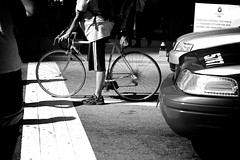
A bicycle ballet at 3rd Ward, the arts and design collective in Bushwick.
A proclamation from Marty Markowitz, the excitable Brooklyn borough president, is no rarity. But receiving it under the head of a quasianimatronic wolf-creature, while, around the corner, a guy upholsters a seat cushion in brown argyle, and another blends cocktails by bike — that is something special.

Blog

ArtsBeat
The latest on the arts, coverage of live events, critical reviews, multimedia extravaganzas and much more. Join the discussion.
Piotr Redlinski for The New York Times
From left, Brooke Smith, Charlie Mirisola and Jason Goodman.
At a party for its fourth anniversary last month, 3rd Ward, the arts and design collective in Bushwick, received a commendation from Mr. Markowitz for its program giving free bicycles to members. But 3rd Ward hardly needed the boost: hundreds of people had come to its brightly painted labyrinthine space to celebrate. Outside were bands and burgers; inside there were demonstrations of screen-printing, woodworking, weaving, designing jewelry and welding, as well as vodka-spiked strawberry lemonade. (A bike was powering the blender.)
Since its inception, 3rd Ward has become something of a D.I.Y. utopia. When Jason Goodman, 31, and his partner, Jeremy Lovitt, 30, conceived of it, it was as a continuation of the facilities and atmosphere they had had as students at the School of the Museum of Fine Arts in Boston: a grown-up art campus. Instead 3rd Ward has evolved into an art and design incubator, where members pay a fee for access to wood and metal shops, photo studios, media labs and other spaces. It attracts hobbyists and professionals alike, as well as dabblers who sign on for a class at a time. As a one-stop network for the creative set, it has managed to be profitable even in a down economy, with annual revenues of about $1.5 million, Mr. Goodman said. It has expanded to a second location, in Williamsburg, and, as of this month, opened a restaurant, Goods, out of a converted trailer nearby.
As a model for the development of a creative business sector, 3rd Ward has attracted attention from other entrepreneurs, community leaders and cities. Six months ago Mr. Goodman and Mr. Lovitt were finally able to quit their day jobs as freelance designers and contractors to focus on 3rd Ward full time.
“We’ve changed a lot,” Mr. Goodman said. “When we opened, because we came from art backgrounds, we were thinking, like, artist, artist, artist, but really it’s like designer, designer, designer, artist. We have way more inventors, furniture makers, cabinet makers, commercial photographers, hackers, than we do what you would originally conceive of like an artist.”
Their success came in identifying a market and tailoring to it. “The industry here that’s really exploding right now, and it’s really underserved, is this freelancing creative industry,” Mr. Goodman said.
Chiun-Kai Shih, 34, creative editor for Condé Nast China, has been a 3rd Ward member for three years, commuting there several times a month from his home on the Upper West Side. He parks his assistant there full time; hired a 24-year-old woodworking teacher, Becky Carter, to build sets for a photo shoot; and, more than a studio, considers 3rd Ward a resource for young talent.
“I just went to the front desk and said, ‘Do you know any great graphic designers,’ and they said, ‘Yes, we’ll give you names,’ ” he recalled.
Mr. Shih holds casting sessions there too. “Even supermodels who don’t like to travel for casting, I drag them out to 3rd Ward,” he said — via car service, of course.
In September 2005, when Mr. Goodman and Mr. Lovitt signed a lease on a 20,000-square-foot shell of a warehouse on a desolate block in Bushwick, they had no business plan. By the time they opened their doors in May 2006, nothing had changed. While they built their clientele and space, they sustained themselves by hosting lavish rent parties in partnership with underground promoters.
The raucous till-dawn affairs, with rooftop fire spinners and marching bands in the hallways, often attracted the attention of the police. After about a year, the parties had to end. If you want professionals to come work during the week, Mr. Goodman said, “you can’t trash a place every weekend.”
Not that 3rd Ward has become a party-free zone: it is still home to art receptions, concerts, barbecues and the occasional blowout. (The underground promoter William Etundi is now on the payroll.)

Friday, July 2, 2010

Thursday, July 1, 2010

BP

Wednesday, June 30, 2010

Lucas Brunelle: Line of Sight Trailer

New Cincinnati bicycle safety ordinance to be one of strictest in Midwest


In addition to the progressive Bicycle Transportation Program unanimously adopted by Cincinnati City Council last week, Cincinnati policy makers also approved safety ordinance that will be one of the most comprehensive of its kind in the region, and even stricter than what is found in Chicago.
“What this plan really does is not add additional transportation infrastructure,” said Gary Wright, President, Queen City Bike. “It adapts the existing transportation infrastructure to new needs in a cost-effective way.”
The new safety ordinance approved 8-0 by Cincinnati’s City Council requires motorists to maintain a three-foot distance when passing bicyclists. The ordinance also makes driving or parking an automobile in a bike lane illegal, and places extra responsibilities on drivers when opening doors as to avoid endangering bicyclists.
“This bike plan can help turn this into the 21st Century city that we all want it to be, one that can look forward to more streets, shops, cafes, and parks filled with people, where people will want to be,” Wright concluded.

Tuesday, June 29, 2010

LCD Soundsystem and Tall Bike Jousting

LAB 2010 State Rankings

1. Washington - Silver*
2. Wisconsin - Silver* 
3. Maine  
4. Minnesota - Bronze*  
5. Oregon - Silver*
6. New Hampshire 
7. Iowa  
8. New Jersey - Bronze*
9. Arizona - Bronze*
10. Delaware - Bronze* 
11. Maryland  
12. Florida  
13. Kansas  
14. Colorado  
15. Massachusetts
16. Michigan  
17. Wyoming  
18. Virginia  
19. California  
20. Nevada  
21. Illinois  
22. Kentucky  
23. Utah  
24. Tennessee  
25. North Carolina
26. Idaho  
27. Indiana  
28. Missouri  
29. Rhode Island  
30. Hawaii  
31. Mississippi  
32. Ohio  
33. South Carolina
34. Vermont  
35. Georgia  
36. New York  
37. Louisiana  
38. South Dakota  
39. Alaska  
40. Connecticut  
41. Texas  
42. Pennsylvania  
43. Nebraska  
44. Oklahoma  
45. Arkansas  
46. New Mexico  
47. West Virginia  
48. Montana  
49. North Dakota  
50. Alabama

Sunday, June 27, 2010

New Home Sales Drop 33% in May; Foreclosures Point to Warning of the Suburban Era


Some bad economic news was reported yesterday. According to the New York Times article new home sales dropped by 33% in May:
The new housing market has never been this bad, at least not since the government started tracking such things in 1963.”
New homes declined by a record amount in May to a new low.”
In a separate report, New Urban News reviewed William Lucy’s new book, Foreclosing the Dream: How America’s Housing Crisis Is Reshaping Our Cities and Suburbs. Mr. Lucy is a professor of urban and environmental planning at the University of Virginia.
According to New Urban News, Lucy’s analysis of data he collected suggests:
• “As the percentage of households with children declines, and that of singles, empty-nesters, and elderly increases, housing demand will increase in cities and inner suburbs, and demand in outer suburbs and exurbs will level off or decline nationally.”
• “Suburban decline will accelerate in middle-aged housing, but that won’t be uniform; demand for housing in some inner suburbs will rise.”
• “Demand will increase for transit serving more areas more frequently.”
• “Demand for more mixed use and walkable neighborhoods will increase, and prices in these areas will escalate as supply lags behind demand.”
He (Lucy) rejects the idea that rapid, continuing, outward development is inevitable because of the nation’s growing population and a scarcity of room for development in cities. If we choose to make it happen, he says, “a tremendously high proportion of our future growth as a nation could easily occur within already developed areas: in, or on the edges of, big-city downtowns; on busy corners of city streets away from downtown; and in new urban villages close to high-speed transit stations in suburbs.”
How each region responds to the challenges of transit and development will vary, producing contrasting results. Greater Atlanta and greater Washington, DC, illustrate the two extremes, in Lucy’s view. “Washington, DC, and some suburban cities and counties planned for transit-oriented development, and use of transit rose to the second-highest level in the United States,” he notes. “Atlanta’s transit use lagged, which may be one reason why Atlanta has the most declining suburbs in the country.”

The gap between city and suburban growth has narrowed dramatically. From Foreclosing the American Dream: How America’s Housing Crisis is Reshaping Our Cities and Suburbs
I don’t think the decline in new-home sales is a total anomaly. New home builders, particularly those that build single family homes in new suburban and exurban communities are going to have a difficult time going forward. Real estate developers that focus on infill and mixed use development as well as TOD should perform better. We are reaching the tipping point; people are leaving the suburbs and returning to the cities.

Saturday, June 26, 2010

Pics from June Critical Mass

Thanks to Jim for the great MJ playlist and thanks for everyone who made it out.

DSC_0238
DSC_0239
DSC_0319
DSC_0309
DSC_0271
DSC_0255

More full Resolutions pictures here

Friday, June 25, 2010

Thursday, June 24, 2010

Friday is Critical Mass and Michael Jackson Dance Party

Join Critical Mass this Friday June 25th SE Corner of courthouse downtown Huntsville. We will be turning the boring streets of Huntsville into a dance party to commemorate the 1st anniversary death of the King of Pop. 

Meet @ 6:30 Ride and Dance @ 7pm 

Best costume gets major applause.
-- 

Krillz for G-shock

Distracted Driving is not Hilarious


From Extraordinary Observations
Straight Outta Suburbia has a great post about how backward the thinking has gotten toward parking and traffic violations in America:
Remember applying for jobs? There's often a question about criminal history that will read something like "have you ever been convicted of a crime except for a minor traffic violation?" I've decided I really hate the premise of this question. What is a "minor" traffic violation? I've got a new premise. If you're in traffic, there are no minor violations. Motor vehicles have the power to maim and kill. Accordingly, we should have a humorless attitude about the safety laws that apply to them.
On the topic of safety and humor. It's been an interesting week regarding traffic safety. First we got this Pew report which shows that adults text while driving at a rate higher than you'd expect. Then on Monday the front page of USA Today published a chart (no permalink available) that shows 'activities people have done while driving' - with the results as:
  • 72% - eaten sandwiches, burgers
  • 29% - kissed
  • 28% - sent texts
  • 23% - taken off clothes
And it's worth bearing in mind that these numbers are conservative, because people actually had to admit to doing them.

(from Flickr user poka0059)

What's worse is how many people describe these statistics as 'fun' or 'funny'. It's really not. People are effectively admitting that they are bad/dangerous drivers. And the worst part is that they probably think of themselves as good or excellent drivers,because thusfar they have multitasked in this way without negative consequences. As Tom Vanderbilt notes in his book Traffic, every time a person drives someplace and doesn't get into a wreck, it bolsters their confidence in their driving skill, even if they had close-calls that could have potentially ended much differently.

This suggests something important about traffic safety. Whenever there is a wreck, whether between cars, bicyclists, pedestrians, or whoever, it's immediately labeled and almost always later described as an 'accident'. But that's not always accurate, because an accident is something that happens ' without an apparent cause'. If someone is texting or changing clothes or eating food and then they smash into something or someone, that's not an accident; that's a wreck caused by the fact that the driver is not operating the vehicle appropriately.

Consider this: if a first-time driver went to the state BMV and in the middle of the final 'road test' started chomping on a sandwich or shooting off text messages, would the state officer deem this person competent enough to possess a drivers license?

Wednesday, June 23, 2010

No More Sympathy For the Impatient Motorist


Perhaps it's a product of the continually growing length of time I have gone without driving (my license is actually expired now pending renewal after I realized), but I am becoming less tolerant and understanding of the wants of impatient drivers and the double standards they apply to other road users. I was waiting to go straight on Broadway Ave. during lunch and practicing my track stand in the process. A driver pulls up and honks at me to get out of the way so she can make a right on red. First of all it is not marked as a right turn only lane, since cyclists can continue through the connecting bike lane. Second of all, rights on red are hazardous to pedestrian traffic by their very nature, and are illegal in more pedestrian oriented places, so I am not inclined to be that sympathetic to someone trying to make a right on red to begin with. If I was in a car waiting to go forward in a lane that was not marked as turn only, there is no way she would have honked, it's a clear double standard of treatment that comes from a belief that even on streets with a bike lane, cyclists do not belong on the road or at least belong on it less than drivers. She asked more nicely out of her window after honking 3 times, but sorry I'm not budging anymore, I'm not going to accept this get to the back of the bus mentality drivers exert over cyclists. By that time the light changed anyways, a delay of perhaps 15 seconds, but to the driver, 15 seconds is often so valuable it is exchanged even when it is risking the lives others.

Sometimes I go through ebbs and flows of more aggressive and cooperative stances with the world of driving. Lately reading the book Fighting Traffic, about the history of the dawn of the auto age in America, has me leaning a little more on the aggressive side. Automobile interest groups and drivers wrestled the purpose of streets from everyone else, often by bloody force (200,000 Americans were killed on roads in the 1920's, a majority were pedestrians back then). It was not uncommon in the early decades of automobiles on the streets for newspapers to depict the typical driver as Satan, and mass memorial services for slain children were common in urban places. Safety campaigns eventually brought down the proportion of pedestrian fatalities, but in the process began to highly limit what had been previously very liberal rights to those who walked in cities. Eventually "motordom", as the auto interests called them selves began influencing the entire design of cities around principles essentially tailored to sell more cars. Auto clubs tried to sell the idea of cars with sexy ads, and promises of freedom, but just as often they were launching campaigns against pedestrians, referring to them as bumbling idiots and creating the term jay walker, blasting against campaigns for car regulation with counter ads that fed on anti-government fears and even stoking racism at times. If we are going to create a culture change of the purpose and dynamics of city streets to be safer and more inviting for all users, we will sometimes have to play dirty too, and we cannot simply back down and make way for every driver who is quick to their horn.

Tuesday, June 22, 2010

How to Trigger Traffic Lights With Your Bike

From EcoVelo


Lined up on the wire
There’s nothing more frustrating than getting stuck at an on-demand signal and having to wait for a car to come up from behind to trigger the light. In some jurisdictions, if you’re unable to trigger the light, it’s legal to proceed after stopping, but that doesn’t help when you’re at a cross street with heavy traffic moving in both directions. The good news is that in many cases it’s possible to trigger a light with your bicycle.
On-demand signals use what they call “induction loop vehicle detectors” to sense when a vehicle is waiting at a light. These detectors are essentially metal detectors embedded into the pavement. They work by sensing changes in an electromagnetic field and have nothing to do with the weight of the vehicle. You can often see evidence of loop detectors as lines cut into the road surface just behind the crosswalk. Wire sensors are embedded in these cut lines, and it’s possible to trigger a light by placing your bicycle wheels precisely on top of one of the wires to disrupt the magnetic field. Some sensors seem to be more sensitive than others; in those cases where the light isn’t initially triggered, I’ve had some success by leaning my bike over toward the inside of the detector loop. In cases where there are two side-by-side loops, lining up over the center where the two loops meet doubles your chances of triggering the light. Once I understood exactly how loop detectors work, my rate of success at triggering lights considerably improved; I’m currently getting somewhere approaching a 90% success rate on the detectors where I live.